Crescent Boat Club is a Philadelphia rowing club at #5 Boathouse Row, 5 Kelly Drive, Philadelphia, PA 19130. The club was organized in 1867 — the date carved on our cornerstone and celebrated at our sesquicentennial in 2017 — the boathouse followed, and we have been a member of the Schuylkill Navy of Philadelphia since 1868. Because the club has never moved, we have rowed from the same bend of the Schuylkill River for more than a century and a half. This is the Crescent Boat Club history our members have long told, corrected where the record demanded it.
Want to be part of the next chapter? See Membership in Crescent and Youth Rowing. Planning a wedding, party, or meeting in a historic boathouse? See Event Space Rentals. Filming or photographing? See our Film and Photography Location Inquiry page. Coming to see the Row? See Visiting Boathouse Row.
On this page: Key Dates · The Club (1867) · The Boathouse (1868) · Expansion (1871–1890) · The Balderston Boathouse (1891) · Rowing, Racing, and Amateurism · Early Races · Crescent and the Schuylkill Navy · The Schools and Scholastic Rowing · The War and Decline · The Rafferty and Ragan Resurgence · The Modern Era · Clean Water, the Water Works, and Our Pilings · Floods, Storms, and the Shutdown · The Lights of the Row · Preserving the House · Sources and Further Reading
The Club (1867)
Crescent Boat Club was organized in 1867, when the Pickwick Barge Club and the Iona Barge Club merged membership. Iona had itself been admitted to the Schuylkill Navy earlier that year and gave up that membership on merging, which is why the two dates sit side by side in our records: the club dates from 1867, and Crescent was admitted to the Navy in its own right in 1868.
The club formed for healthful rowing and gentlemanly fellowship, and it received permission to build along the river below Lemon Hill — the first parcel of what became Fairmount Park — on ground that had once been part of the estate of Robert Morris, signer of the Declaration of Independence and a principal financier of the Revolutionary War.
The Row we joined was already taking its modern shape. The Schuylkill Navy, the oldest amateur athletic governing body in the United States, had been founded by nine clubs on October 5, 1858. The city began asserting control over what could stand on the riverbank with its first ordinances in 1860, requiring sturdier houses of brick and stone in place of the old frame sheds, and the new Fairmount Park Commission of 1867 took up that authority. Crescent was formally incorporated in 1874.
The Boathouse (1868)
Crescent built a substantial stone building to house the boats, and enlarged it, with our Pennsylvania Barge Club neighbor, into the twin house that stood by 1871. Crescent rowed out of the upriver bay and Penna Barge the downriver bay, and the two clubs shared one simple gabled building. The club’s own records date the house to 1868; the National Register nomination for Boathouse Row dates the completed stone double house to 1869 through 1871, and reads 1868 as the year permission to build was granted. Both accounts describe the same building going up in the same few years.
Even that first house carried a small ambition: its door was set deliberately off center. In his study of the Row’s architecture, the historian Thomas G. Beischer treats that kind of detail as the beginning of something — municipal control over the riverbank loosened after the Centennial of 1876, and the clubs, freed to build as they liked, began competing with one another in brick and stone. Crescent would take part in that competition twice.
Expansion (1871–1890)
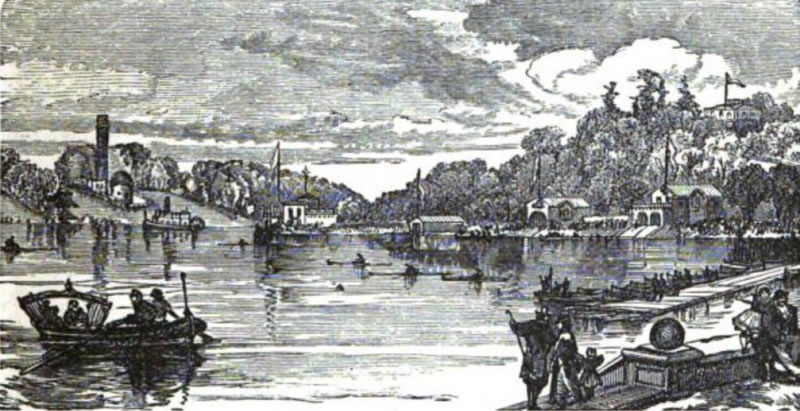
Soon after the turn of the decade, Crescent and Pennsylvania expanded the building. The enlarged house had three boat bays on the ground level, with lockers and reception rooms above, a new Crescent tower, and a large skylight over the locker room. The work was drawn by Davis E. Supplee — a rower and a Crescent member, and an architect practicing in the city from the 1860s, whose father’s building firm may have raised our first house — and was completed by 1873.
That work left evidence inside the walls. When members were renovating the interior in early 2012, they found a section of stairway hidden behind the bar that had once led up to the roof and the skylight, and they found the beams that span the boat bays and carry the masonry above them. Rolled iron, not steel, was the structural standard in Philadelphia when this part of the house went up; structural steel sections did not come into common American building use until the later 1880s and 1890s.
Our neighbors’ crew sat for the most famous painter of this river in these years. In about 1874 Thomas Eakins painted the four of the Pennsylvania Barge Club — the club occupying the downriver half of our own building — in the picture usually called Oarsmen on the Schuylkill. Eakins had painted Max Schmitt on this water in 1871. The stretch of river in those canvases is the stretch outside our doors.
One landmark keeps recurring in photographs of this reach: the Spring Garden Street bridge, Charles Ellet Jr.’s wire-cable suspension bridge of 1842, the first successful bridge of its kind in America. It was 357 feet long and only 18 feet wide, and it carried traffic from the city to Mantua and West Philadelphia until it was taken down in 1874 and replaced the following year.
The Balderston Boathouse (1891)
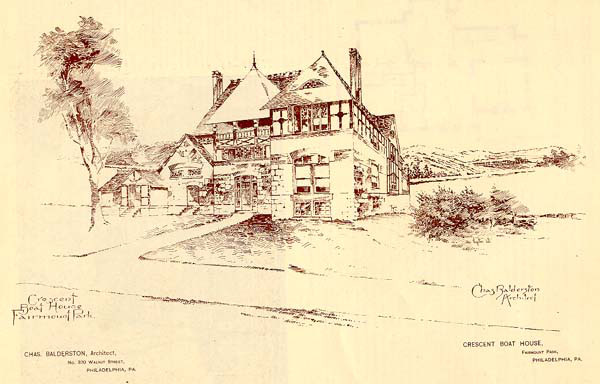
By the end of the 1880s, the growth of the club, the city, and rowing itself required another enlargement. It was the era of architectural one-upmanship on the Row — Frank Furness’s firm had built Undine’s house in 1882 — and Crescent engaged the Philadelphia architect Charles Balderston. Balderston had trained under Samuel Sloan, practiced as a partner in Sloan & Balderston, and set up on his own account in 1883.
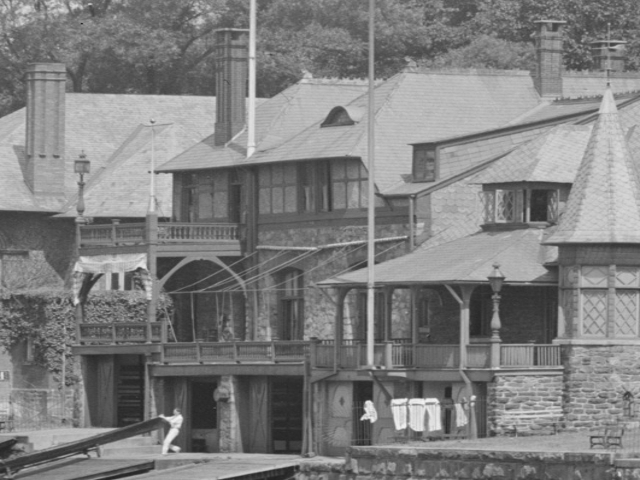
He proposed raising the roof, adding another bay for the boats, and recasting the exterior above the original two stories of stone: half-timbered brick and stucco in the late Victorian fashion, with tall brick chimneys and eyebrow windows set into the roof. The work was finished in 1891, and the date-stone records both halves of the story at once — 1867 Crescent 1891. Apart from a small enlargement of the downriver boat bay in the 1960s to take the over-sixty-foot eights, Balderston’s house is the building that stands today, part of the Boathouse Row designated a National Historic Landmark on February 27, 1987.
Built on soft ground
The Balderston wing was built on soft soils. Nearly all the boathouses raised on the Row in the later 1800s stand on timber pilings driven into the alluvial silt that collected after the Fairmount Dam and Water Works were built. The impoundment that did Philadelphia so much good — fewer summertime yellow fever outbreaks, clean water pumped to the Fairmount Reservoir and delivered by gravity to every house in the city — also slowed the river’s current. The dam, completed in 1821, and the city’s purchase of farms up the watershed, which occasioned the largest park within any American city, together built up the soft bank the later boathouses were founded on.
Crescent’s new wing tipped downward at the river side. The settlement eventually slowed, but not before the floor took a permanent set, and in the later twentieth century the timber pilings beneath the wing began to deteriorate again. The building is moving still.
A marble set down on the reception room floor rolls from one side of the room to the other, descending nine inches on the way.
Rowing, Racing, and Amateurism
Rowing was growing as a spectator sport as well as a participant one. Through the 1860s and to the end of the century it developed as a commercial enterprise, with large crowds, heavy betting, and prize money for the rowers. The clubs that banded together as the Schuylkill Navy in 1858 did so in part to regulate themselves and curb the gambling, and to preserve room in the sport for competition without the professionalism that was taking it over.
Crescent chose to be a place for amateurs, joining the other Navy clubs in those ideals and then joining the National Association of Amateur Oarsmen, founded in 1872 and now USRowing. The NAAO was the first American governing body for a team sport to publish a definition of the amateur, which mattered because until then every regatta used its own. The word has since acquired a second meaning — bush-league, second-best — that it did not carry then, when an amateur was simply someone who did the thing for love of it.
Who could afford to row
That ideal had class implications in the nineteenth century. Only the affluent could afford the pastime, the leisure, and the boats. There were fine rowers whose day job was pulling boats and barges along the Schuylkill and its commerce-laden canals; they were declared professionals too, and there is no evidence they were welcome at Crescent in the years when its membership was architects, doctors, and men of law and commerce.
Boathouse Row opened to the working classes early in the next century, and to women and to people of color later in it. The name Kelly is known to most Philadelphians: John B. Kelly Sr., a bricklayer from East Falls, won Olympic gold in the single and double sculls at Antwerp in 1920 after Henley had refused his entry for the Diamond Sculls. He was one of a larger group of men who were great rowers in their prime and then great advocates of widening the sport, opening the river to the rowhouse kids and the sons of immigrants and to the high schools they attended. Bear Curran, John Wilkins, Paul Costello, and Charles McIlvaine built and coached school programs through the 1930s and into the war years. Crescent’s own scholastic tradition, below, came directly out of that work.
Early Races
An early distinction belongs to Crescent’s oarsmen. On Thanksgiving Day 1872, Crescent and Undine rowed the first eight-oared shell race ever held in this country, in long slender boats brought over from England. The accounts differ in their details: Undine’s own history and Pennsylvania Heritage put the race on November 28 between two clubs, while the Schuylkill Navy’s account dates it November 18 and adds a third crew, from the West Philadelphia Boat Club, now Penn AC. No surviving race report names the winner.
The following autumn the National Association of Amateur Oarsmen held its first National Regatta on the Schuylkill, opening on October 8, 1873, and Crescent won at it. Which event is less certain than the fact. Crowther and Ruhl’s Rowing and Track Athletics of 1905 credits Crescent with the double sculls; the club’s own tradition remembers a win in the eights, by three-quarters of a length over Undine and West Philadelphia. The two are not necessarily in conflict, and no contemporaneous race report has yet been found to settle it.
Many victories followed. One of them survives as an object: a silver-plated presentation mug inscribed for a Crescent four-oared shell race of May 25, 1895, now in the collection of the Mystic Seaport Museum in Connecticut.
Crescent and the Schuylkill Navy
The Schuylkill Navy of Philadelphia — organized on October 5, 1858 by nine clubs, and the oldest amateur athletic governing body in the United States — has governed rowing on this stretch of river since before Crescent existed. Crescent was admitted in 1868 and has been a member club ever since, sending delegates to the Navy’s councils, flying its flag at the Navy’s observances, and racing under its rules for over a century and a half.
Membership in the Navy means the great regattas of American rowing pass directly by our dock. The Stotesbury Cup, rowed since 1927 and the largest high school regatta in the world; the Independence Day Regatta; the Navy Day Regatta; the Dad Vail, a Philadelphia fixture since 1953, when the Navy persuaded it to come to the Schuylkill; and the Head of the Schuylkill, since 1971 — all of them race the water in front of #5, and Crescent’s crews, members, and volunteers have taken part in all of them.
The cooperation among the Navy’s clubs is not ceremonial. When the river itself needed saving, it was the Navy’s River Restoration Committee that raised the first $4.5 million toward the modern dredging of the Schuylkill, Crescent among the clubs pulling together.
The Schools and Scholastic Rowing
John Wilkins was Crescent’s man. After his competitive career he built and coached a program for students from Father Judge High School inside Crescent, and his wife was one of the founders of the Philadelphia Girls’ Rowing Club. Wilkins lived until the late 1990s and mentored the club’s present white-hairs when they were young.
The tradition he began has never left the house. Over the decades Crescent has been home water to a succession of Philadelphia-area high school crews. Father Judge rowed here in the Wilkins era, and Northeast Catholic boys are remembered in our bays by members who were there. The Archbishop Prendergast girls kept boats at Crescent, and their program rows on today as Bonner-Prendie.
Merion Mercy Academy rowed from our racks after its crew was founded in 2005; by the club’s account their coach was named the Schuylkill Navy’s Coach of the Year in 2011, the same year the crew won at the Henley Women’s Regatta in England. Roman Catholic High School re-established its program in 1995 and was taken in by Crescent, rowing here for some two decades. Our records credit its varsity quad with the City Championships, the Stotesbury Cup, and Scholastic Nationals in the same season, three years running at the turn of the century. Each of those crews has since moved on to other houses, and each carried a piece of Crescent with it.
Today the scholastic and collegiate oars in our bays belong to Harriton Crew and to Thomas Jefferson University women’s rowing. See Youth Rowing for the club’s own programs.
The War and Decline
Crescent remained an active and competitive club through the early 1940s. Then, because membership fell away after the war, the club turned the operation of the boathouse over to the La Salle Rowing Association from 1951 to 1960.
The Rafferty and Ragan Resurgence
After La Salle vacated the house, John Wilkins — by then president, and a member since the 1920s — invited Tom Rafferty to bring his high school rowers to Crescent. Rafferty and Steve Neczypor became club members and brought their crews in as student members. Raf had been coaching young high schoolers off a precarious dock at a warehouse in Manayunk, and they brought their boats to #5.
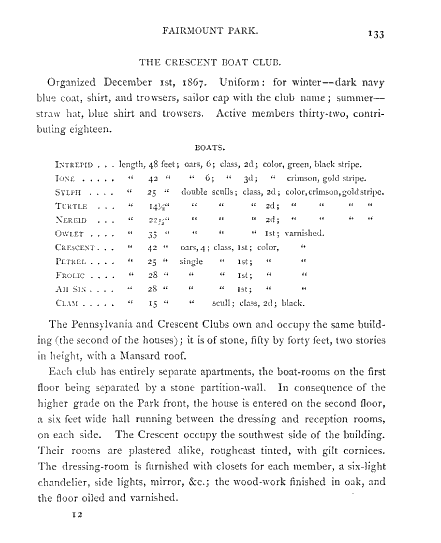
The roof was leaking and the floor joists were sagging with rot. Trophies, cups, and medals had gone missing along with the furniture, windows were without glazing, and feral dogs lived in the boat bay. Little of what Keyser described in 1876 remained: some of the roughcast tinted plaster, but none of the cornices, gilt or otherwise. While Tom coached, Steve began to stabilize and strengthen the building.
Rowing for Raf, and building for Nez, were David Ragan, the Kealey brothers Joe and Tom, Tom Daley, Bob Coco, Dave Serdar, and Curt Goldacker. They rowed in the mornings and fixed the boathouse on weekends and after the regattas. Rafferty, a plumber by trade, rescued materials from job sites, and slowly the house acquired central heating, flush toilets, interestingly tiled showers, steel I-beams, and an assortment of doors, windows, and light fixtures. The club was once refused a permit by the Philadelphia Historical Commission to replace a window in the boathouse; the Commission does not, yet, consider it its job to preserve the architecture of well-known Philadelphia plumbers. The club takes a different view.
Were it not for Nez and Raf and the young men they taught, the building would be in the Schuylkill rather than alongside it.
The Modern Era
Programs and oarsmen
Since the 1970s Crescent has grown through novice, junior, and masters programs. The summer junior program continues to flourish, with many summertime victories and solid representation at the Royal Canadian Henley; the club’s records credit three Canadian Henley championships to our U19 and U23 crews.
Among the boys who came down to the river was Glenn Ochal of Roxborough, who began rowing at Roman Catholic and Crescent in 2001. He went on to Princeton, and between college and the national team he coached Crescent’s summer youth programs, as Crescent men always have. He rowed on ten United States national teams, won a bronze medal in the coxless four at the London Olympics in 2012 — the year USRowing named him its Male Athlete of the Year — and raced the eight at Rio in 2016.
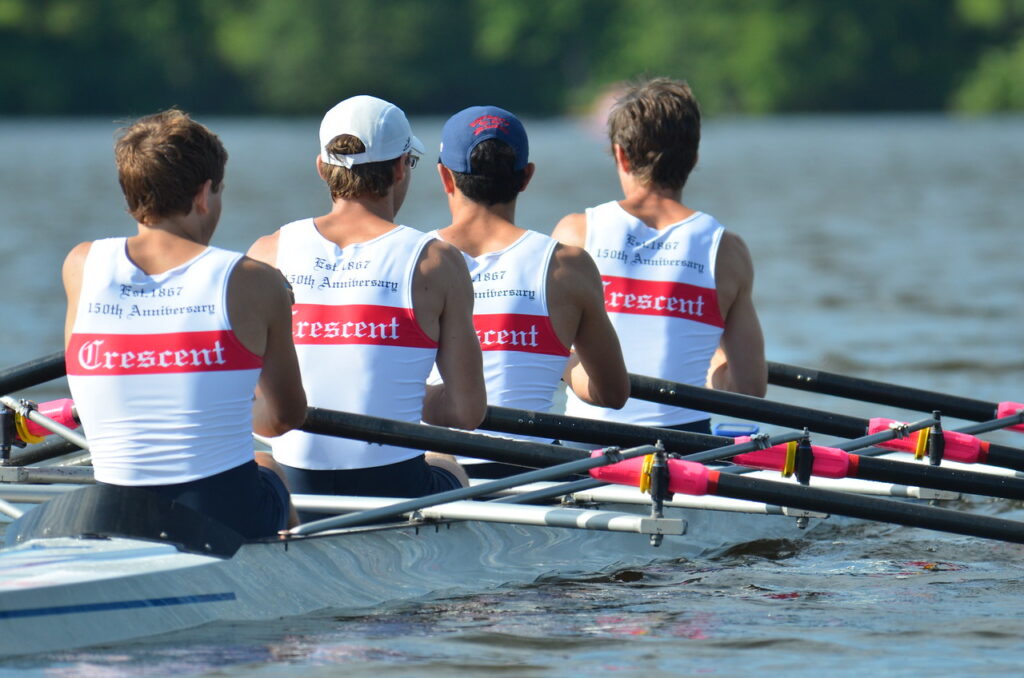
In our sesquicentennial summer of 2017, four young men from Crescent, three of them Roman Catholic alumni, won the trials and represented the United States in the lightweight quadruple sculls at the World Rowing Under 23 Championships in Plovdiv, Bulgaria, in July. USRowing entered the crew under the club’s name. Crescent sent them the old-fashioned way: hamburgers on the deck, a 50/50, and the generosity of members and friends.
The 2012 remodeling
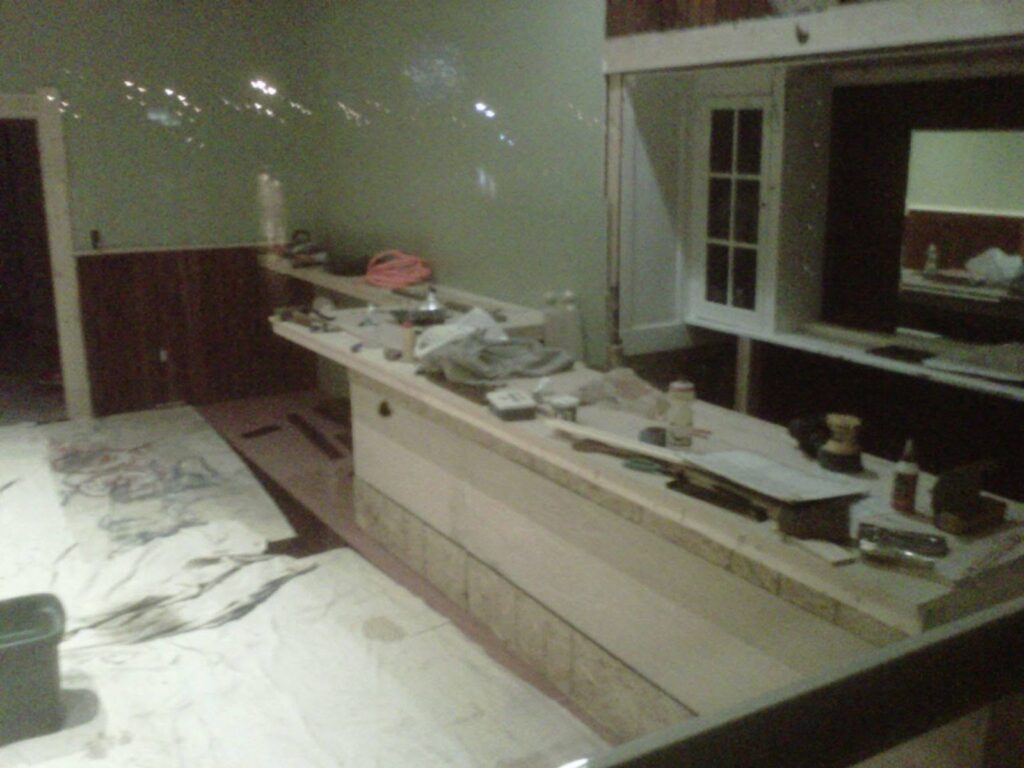
The house has been worked on throughout. In 2012 the club remodeled the second-floor club room and bar: members built a new bar, cut in the doors that open onto the deck added over the water, and built out the kitchen. That work is the reason the room can hold a wedding today, and it is the room described on our Event Space Rentals page.

Resident crews and caretakers
Collegiate rowing came back to the house in 2016, when the women’s program of Philadelphia University began rowing from Crescent. Philadelphia University merged into Thomas Jefferson University the following year, and Jefferson women’s rowing has trained from our dock since 2021 under a lease that runs to 2029.
Someone has also lived here. Since at least 2014 a caretaker has lived full time in the tower, up by the old observation deck, maintaining and securing the club: John Snyder in earlier years, John Pagano from 2014, and today Troy Madden, the club’s rental manager and caretaker. In the summers the tower apartment has also housed traveling rowers who came to Philadelphia for our programs. Current appointments and officers are listed on Club Officers & Officials.
On camera
The cameras found us too. Boathouse Row is one of the images Philadelphia shows the world — the run up Kelly Drive, the skyline beyond the Water Works, the lights on the water — and film, television, and commercial crews have worked this stretch of river for decades. Crescent has hosted shoots inside the old house, where the boat bays, the tower stair, and the Victorian rooms need no dressing to look like what they are. Productions start with our Film and Photography Location Inquiry page.
Clean Water, the Water Works, and Our Pilings
It is worth remembering why this park exists at all. Philadelphia did not set aside these thousands of acres for beauty, or for us. The city built the Fairmount Water Works below our house to deliver clean water, bought Lemon Hill and then farm after farm up the watershed to keep that water pure, and in 1867 created the Fairmount Park Commission to hold the ground. Fairmount Park is, at bottom, a drinking-water protection scheme that became the largest park within any American city, and the flat water it made behind the dam is the reason there is rowing here.

1909
The Fairmount Water Works stopped pumping the city’s drinking water.
1972
The Clean Water Act began the long recovery of the Schuylkill.
9 in.
The drop a marble rolls across the reception room floor.
That protection did not hold. By the early twentieth century, industry up the valley had fouled the Schuylkill and very little could live in it. The Water Works stopped pumping drinking water in 1909. What followed was a long municipal repair: the Clean Water Act of 1972, and the Philadelphia Water Department’s long campaign, carried on today under Green City, Clean Waters, to keep stormwater and sewage out of the river. The fish came back. The shad run again past our dock.
The recovery is real, and we row on the results of it every day. It has not spared the foundations. The timber pilings under the Balderston wing continue to deteriorate, the marble still rolls its nine inches, and holding the wing level is now a permanent line in the club’s planning.
Floods, Storms, and the Shutdown
The river has never let us forget what it is. The benchmark against which everything on this Row is still measured is the flood of October 4, 1869 — two years after Crescent was organized — when the Schuylkill rose to about seventeen feet and the Fairmount Dam vanished under more than eleven feet of water. Every generation here has had its own high-water mark.
| Date | Storm | Crest above the dam | On the Row |
|---|---|---|---|
| Oct 4, 1869 | Saxby Gale remnants | ~17 ft (record) | Fairmount Dam submerged; the Row under water |
| Jun 23, 1972 | Hurricane Agnes | 14.65 ft | Boathouse Row flooded to the promenade |
| Sep 16–17, 1999 | Hurricane Floyd | 14.1 ft | Record single-day rainfall; crews hauled boats |
| Jul 12, 2019 | Summer storms | 11.58 ft | Water in the boat bays |
| Aug 4, 2020 | Tropical Storm Isaias | 13.28 ft | A dredging barge broke loose and struck the I-676 bridge |
| Sep 2, 2021 | Hurricane Ida remnants | 16.35 ft | Highest since 1869; docks and launches lost along the Row |
Ida, 2021
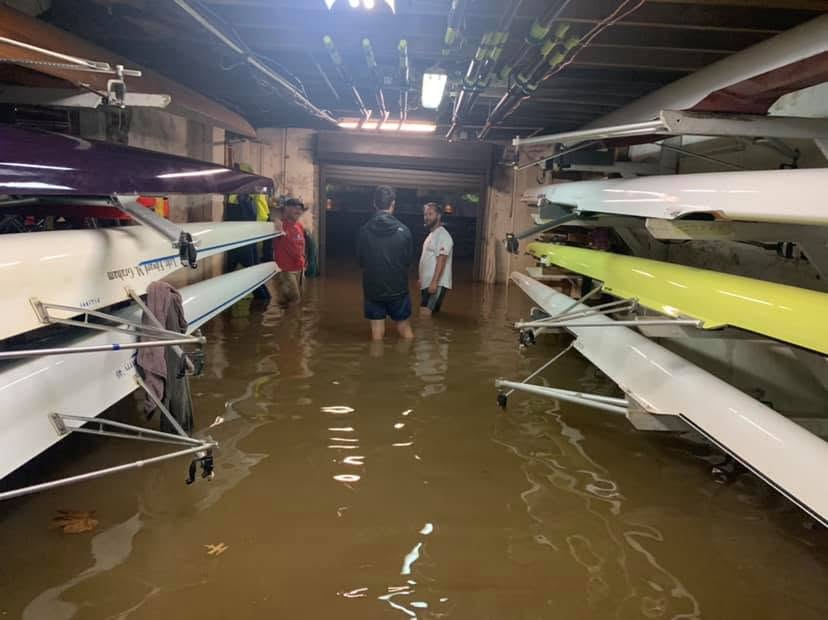
The remnants of Hurricane Ida came through on the night of September 1, 2021, and by the next morning the Schuylkill stood at 16.35 feet, the highest level recorded at the gauge since it began operating in 1931 and second only to the seventeen feet estimated in 1869. Boathouse Row stood surrounded by water. Up and down the Row, docks were torn away and coaching launches went down the river, some recovered as far south as the Delaware. Kelly Drive, West River Drive, and the Vine Street Expressway all went under, and the safety curtain strung across the river above the dam was damaged badly enough to need replacing. It was the third such reckoning in living memory, after Agnes in 1972 and Floyd in 1999.
The shutdown, 2020
The year before had taken something else from us. In the spring of 2020 the boathouses closed under the Governor’s order, and for a season the Row went silent: the Dad Vail was canceled, and so was the Stotesbury Cup, the largest high school regatta in the world. We were back on the water that August, and by the spring of 2021 the regattas were rowing on the Schuylkill again.
The dredge, 2020–2023
The river bottom had its own chapter. The slowed current that silted the bank under our pilings never stopped working, the Schuylkill above the dam had not been dredged since 1999, and the water off our dock was barely a foot deep. The clubs of the Schuylkill Navy raised $4.5 million to dredge it, and the docks came out along the Row in the spring of 2020 so the work could begin.
Then it stalled. The contractor stopped work in November 2020, saying the riverbed held more debris than the contract allowed for — telephone poles, railroad ties, and the rest — and a pandemic and Isaias’s runaway barge did not help. Federal infrastructure funding eventually brought the project to $13 million. In October 2022 the channel in front of Boathouse Row was cleared at last, with 28,000 cubic yards of sediment taken out and barged to Fort Mifflin. The dredge moved upriver to the racecourse the following summer and pulled more than three thousand illegally dumped tires out of the Schuylkill, which stalled that phase in its turn.
The Lights of the Row
Our house has been part of Philadelphia’s most famous nightscape since October 1979, when the lighting designer Ray Grenald outlined the boathouses in strings of white bulbs. Grenald had pitched the idea to Mayor Frank Rizzo as a way of drawing attention to buildings that were then deteriorating and, in some quarters, spoken of for demolition; the whole installation cost about $55,000. The lights first came on the same month Pope John Paul II visited the city, and the two have been linked in the telling ever since, though Grenald’s family says the houses were not lit for the visit. The lights became LED in 2005, were refreshed in 2016, and then went dark in March 2023 for a complete rebuild, which gave several houses along the Row their first chance in decades to repair roofs and façades hidden behind the wiring.
On March 7, 2024, before a crowd gathered along the west bank, the Row was lit again: a $2.1 million system of 6,400 programmable lights capable of sixteen million colors, tracing ten of the buildings, stewarded by the Fairmount Park Conservancy with Philadelphia Parks & Recreation and funded by the Joanna McNeil Trust and the City. Ray Grenald had died the day before, at 96. The Row is programmed as one display rather than club by club, which is about right. Our building glows as one link in that chain, whether the Row is Eagles green, rainbow for Pride, or something no one has tried before.
Papal visits have a way of finding this river. When Pope Francis came to Philadelphia in 2015, the Schuylkill in front of the Row was closed to rowing for the weekend. Visiting Boathouse Row has the best places to stand and when the lights come on.
Preserving the House
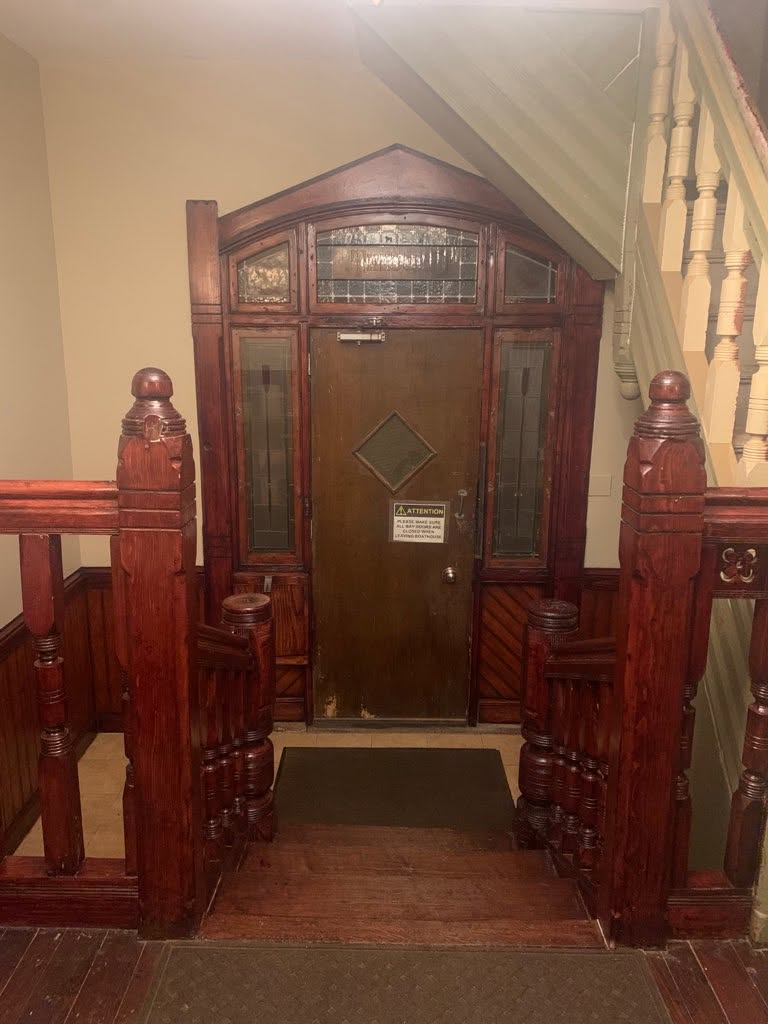
Club members are mounting a long effort to protect, preserve, and restore the old building. Some of that work is slow and close: Troy and other members have been removing decades of paint from the wood and wood trim of the club’s entrance, bringing the old grain back into the light one layer at a time.
It is done out of respect for the building’s history, and in the hope that the house can go on for another hundred and fifty years as a place for Philadelphians to row, enjoy the river, and enjoy one another’s company.
If you would like to be part of that, start with Membership in Crescent — or come and see the house at an event.
Sources and Further Reading
- Dotty Brown, Boathouse Row: Waves of Change in the Birthplace of American Rowing (Temple University Press, 2016) — the definitive history of the Row.
- Thomas G. Beischer, “Control and Competition: The Architecture of Boathouse Row,” Pennsylvania Magazine of History and Biography 130, no. 3 (2006) — the scholarly architectural history of the Row and our house.
- Charles S. Keyser, Fairmount Park (1876) — the earliest published description of Crescent’s house, free at the Internet Archive.
- Samuel Crowther and Arthur Ruhl, Rowing and Track Athletics (Macmillan, 1905) — the earliest published account of Crescent’s win at the first National Regatta of 1873.
- Boathouse Row National Historic Landmark nomination (National Park Service, reference 87000821, listed February 27, 1987), and the Historic American Buildings Survey record for the Row.
- The Schuylkill Navy of Philadelphia. More archives, regatta records, and river resources on our Rowing Links page.
Page reviewed and sources verified September 2026. Where the club’s own records and outside sources disagree, both are given. Corrections and additions from members are welcome — see club information.