Visiting Boathouse Row is free. It is open every day of the year, and you do not need a ticket. Crescent Boat Club is a Philadelphia rowing club at #5 Boathouse Row, 5 Kelly Drive, Philadelphia, PA 19130. We were founded in 1867, and we have belonged to the Schuylkill Navy of Philadelphia since 1868. Boathouse Row itself is a National Historic Landmark. Fifteen nineteenth-century clubhouses stand along Kelly Drive, lit after dark. The clubhouses are private. However, the riverfront path in front of them belongs to everyone.
This guide to visiting Boathouse Row is written from inside one of the boathouses. So it covers what the general visitor guides miss: where the restrooms actually are, which buildings upriver are also boathouses, and the hidden staircases most Philadelphians have never climbed.
Here to row? See Rowing Links. Planning a wedding, party, or meeting? See Event Space Rentals. Scouting a shoot? See Film and Photography Location Inquiry.
Just visiting
The path, the lawns, and the views are free and open every day. Start at Lloyd Hall, then work outward.
Here to row
Club contacts, river conditions, flow limits, and the full racing calendar for the Schuylkill.
Booking an event
Our second-floor room seats up to 140, with a deck over the river. Dates and pricing come back through the form.
Filming or shooting
An 1868 boathouse used for film, television, and photography. Access, timing, and permits explained.
On this page: Getting Here · Practical Facts · The Fifteen Boathouses · The Riverbank · Water Works and Art Museum · The First Two Miles Up · Grandstand and Bridges · Boathouses Upriver · Mansions, Music, East Falls · West Fairmount Park · Downriver Past the Dam · Trails and Tours · Watch the River Live · Where to Eat · Weddings and Events · Common Questions · Planning a Trip

Distances From Lloyd Hall
Lloyd Hall is #1 Boathouse Row, at the downriver end, and it is the only public building on the Row. It is also the one address a taxi, a delivery, or a phone map will find without argument, so every distance on this page is measured from its front door. Crescent sits 0.15 miles north of it, a three-minute walk. The far end of the Row is half a mile up, about ten minutes. The famous part is small; everything else here radiates out from that one point. Walking times assume an unhurried three miles an hour, and a bike roughly quarters them.
| Destination | Miles | On foot |
|---|---|---|
| Lloyd Hall (#1) — restrooms, cafe, bike rental | 0 | — |
| Crescent Boat Club (#5) | 0.15 | 3 min |
| The Sedgeley Club (#15), north end of the Row | 0.5 | 10 min |
| Azalea Garden | 0.2 | 4 min |
| Fairmount Water Works | 0.3 | 6 min |
| Art Museum, Rocky steps and statue | 0.4 | 8 min |
| Lemon Hill steps and mansion | 0.4 | 8 min + climb |
| Fairmount neighborhood restaurants | 0.7 | 14 min |
| Glendinning Rock Garden | 0.9 | 18 min |
| Girard Avenue Bridge | 1.0 | 20 min |
| Philadelphia Zoo | 1.3 | 26 min |
| The Three Angels, Fountain Green | 1.5 | 30 min |
| 30th Street Station | 1.6 | 32 min |
| Schuylkill Banks Boardwalk | 1.8 | 36 min |
| City Hall | 2.0 | 40 min |
| Gillin Boathouse and BLJ, 2200 Kelly Drive | 2.2 | 44 min |
| The grandstand and finish tower | 2.3 | 46 min |
| Strawberry Mansion Bridge, Furness arch | 2.5 | 50 min |
| Belmont Plateau | 2.5 | 50 min |
| East Park Canoe House, 2400 Kelly Drive | 2.6 | 52 min |
| Falls Bridge | 3.3 | 66 min |
| East Falls, In Riva, farmers market | 3.6 | 72 min |
| Wissahickon Transit Center | 4.2 | 84 min |
| Bartram’s Garden | 4.3 | 86 min |
| Main Street Manayunk | 6.0 | 2 hrs |
Getting to Boathouse Row
Most people visiting Boathouse Row walk in from the Philadelphia Museum of Art. That is 0.4 miles, or eight minutes. Riders come along the river trail instead. Either way, aim for Lloyd Hall first.
On Foot and by Bike
- From City Hall – About 2 miles straight down the Benjamin Franklin Parkway. That is a forty-minute walk, or ten minutes by bike.
- From University City – Penn and Drexel sit about 2.5 miles down the river trail. The ride is flat, and there are no road crossings. So it is the easiest approach from anywhere in West Philadelphia.
- Indego bike share – The city’s blue bikes. Indego has pushed docks out along Kelly Drive and into East Falls. As a result, the river corridor now works point to point. Check the live map before you set off.
- Wheel Fun Rentals – Bikes, tandems, and surreys, right beside Lloyd Hall. Naturally it books out on weekends. 0 miles.
Transit and Rideshare
- Bus – Several SEPTA bus routes stop at the Art Museum. From there it is 0.4 miles, or eight minutes on foot, to Lloyd Hall. This is the simplest transit approach.
- Routes and schedules – SEPTA’s own route finder, for planning any bus, Metro, or Regional Rail trip to the Art Museum stop.
- City Hall Station – The hub of the SEPTA Metro network, where the B (the old Broad Street Line), the L (the old Market-Frankford Line), and the T trolleys all meet. Signage now uses the letters rather than the old names. From the station, walk or ride straight out the Benjamin Franklin Parkway to the river. 2 miles from Lloyd Hall.
- 30th Street Station – Officially the William H. Gray III 30th Street Station, and the arrival point for almost everyone coming from out of town. Amtrak and SEPTA Regional Rail both stop here, and the SEPTA Metro L and T call next door at Drexel Station at 30th Street. The river trail runs north from the station to the Row without a single road crossing, so it is the easiest arrival of all. Note that the station has been under a multi-year renovation since 2023, so entrances move. 1.6 miles by trail.
- Wissahickon Transit Center – The new bus hub at 5000 Ridge Avenue, opened in December 2025. It replaced the old bus loop with a much larger building, full accessibility, indoor waiting, and restrooms. Eleven bus routes stop here, and the Wissahickon Regional Rail station is a short walk away. So you can start at the top of the river, then ride or walk down to the Row. 4.2 miles.
Seasonal Buses and Rideshare
- Philly PHLASH – The seasonal loop bus, with a stop at Pennsylvania and Fairmount Avenues. It runs daily from Memorial Day to Labor Day.
- Rideshare – Always ask for Lloyd Hall or the Lloyd Hall parking lot. Because the rest of the Row is a park road with nowhere to stop, no other pickup point works.
Driving, Parking, and Road Closures
- Museum garage – The Art Museum’s underground garage sits 0.4 miles from Lloyd Hall. It is the largest reliable paid parking near the Row. On a busy day, it is the sane choice.
- Lloyd Hall lot – Frankly it is small and time-restricted, and it fills by mid-morning on weekends. Still, it is the only lot actually on the Row.
- Free parking upriver – The lot under the Twin Bridges at 4100 Ridge Avenue holds fifty cars. It sits 3.6 miles up, at East Falls. Locals, meanwhile, use it as a trailhead.
- West River Drive, car-free on weekends – Martin Luther King Jr. Drive is the far bank, directly opposite. Older Philadelphians still call it West River Drive. It closes to traffic on weekends through the warmer months. Check the city for the current season, because event weekends are sometimes excepted.
- Regatta closures – Kelly Drive shuts to cars for the major races. Check before you drive.
At Lloyd Hall: the Practical Facts
People visiting Boathouse Row ask us about restrooms more than anything else. The answer is Lloyd Hall. Sort that out before you head upriver, because nothing reliable follows it.
Restrooms, Water, and Access
- Lloyd Hall, Philadelphia Parks & Recreation – The city’s own record for #1 Boathouse Row. It lists public restrooms and a water fountain, both reachable straight off the trail. There is also a café, bike rental, and indoor basketball with public hours.
- Restrooms upriver – Do not count on any. Facilities at the other boathouses serve members and crews. Anything else that appears in racing season is usually portable and seasonal.
- Accessibility – The riverfront path is paved, level, and step-free for miles in both directions. The boathouses themselves are Victorian buildings, so most have steps at the door.
- A little history – Lloyd Hall was built between 1994 and 1998, on the site of Plaisted Hall. It honors James R. Lloyd, a state senator and park commissioner.
After Dark, and on the Water
- Lighting and cameras – Boathouse Row is lit every night, and security cameras cover it. Kelly Drive and the river path are generally lit too. Runners are out well into the evening.
- The catch – The parking lots along Kelly Drive close at night. So do not leave a car in one if you plan to stay late for the lights.
- Fishing – This is a good stretch to fish, and rods line the bank all season. Licenses and boating rules come from the Pennsylvania Fish and Boat Commission. Swimming, however, is never permitted here.

The Fifteen Boathouses
Start at Lloyd Hall and walk north. Certainly this is the core of visiting Boathouse Row, and the whole Row takes ten minutes. The clubs are private, so none runs drop-in tours. Several do rent their halls, though, and all of them race on the water in front of you. Numbers 3 and 8 adjoin their neighbors rather than housing separate clubs.
#1 to #7: the First Two Minutes
- #1 Lloyd Hall – The only public boathouse. Consequently it handles gym, restrooms, café, and bike rental. 0 miles.
- #2 Fairmount Rowing Association – Founded 1877 by workingmen from the Fairmount neighborhood. They were refused entry to the Schuylkill Navy for decades before finally getting in. 0.05 miles.
- #4 Pennsylvania Barge Club – Founded 1861. Additionally it hosts the Pennsylvania Center for Adapted Sports, which runs adaptive rowing here. 0.12 miles.
- #5 Crescent Boat Club – Our house, three minutes from Lloyd Hall. Crescent formed in 1867 when the Pickwick and Iona barge clubs merged. The boathouse followed in 1868, under one roof with Pennsylvania Barge. Then the 1871 expansion added the third bay and the street-side tower, designed by Davis Supplee, a rower and club member. Finally, Charles Balderston revised the exterior in 1891. 0.15 miles.
- #6 Bachelors Barge Club – Founded 1853, and the oldest continuously operating rowing club in the country. Its first constitution required every member to be a bachelor. 0.18 miles.
- #7 University Barge Club – Founded 1851, and a founding member of the Schuylkill Navy. It also organizes the Head of the Schuylkill Regatta. 0.2 miles.
#9 to #15: the North End
- #9 Malta Boat Club – Founded 1860. Since 1899 the Thanksgiving morning Turkey Trot has started from its steps. 0.25 miles.
- #10 Vesper Boat Club – Founded 1865 as the Washington Barge Club. John B. Kelly Sr. rowed here before the split that sent him to Penn AC. 0.28 miles.
- #11 College Boat Club – The Burk-Bergman Boathouse, owned by Penn. Notably it is the only all-collegiate house on the Row. 0.3 miles.
- #12 Penn AC Rowing Association – Founded 1871 as the West Philadelphia Boat Club. Since then it has been a steady pipeline to the US national team. 0.33 miles.
- #13 Undine Barge Club – Founded 1856. Frank Furness designed its 1883 boathouse, and that building set off the architectural competition that shaped the rest of the Row. 0.38 miles.
- #14 Philadelphia Girls’ Rowing Club – The oldest women’s rowing club in existence, in the oldest building on the Row. Remarkably it dates from 1860. 0.42 miles.
- #15 The Sedgeley Club – A women’s social club built in 1902 around the Turtle Rock Lighthouse. Today it marks the north end of visiting Boathouse Row on foot. 0.5 miles.
- The lights – How the strings outlining each boathouse work, and why the colors change for city occasions.

The Riverbank: Lawns, Picnics, and Blossoms
Frequently, guides skip the best part of visiting Boathouse Row. It is not the buildings. Rather, it is the bank they sit on. Wide open grass runs down to the water, unfenced, for two miles north of Lloyd Hall. In fact, this is some of the largest free public lawn in Philadelphia. Even so, hardly anyone claims it.
Picnics and Playing Fields
- Picnicking – Spread a blanket anywhere on the bank. An ordinary picnic needs no permit in Fairmount Park. However, organized gatherings, tents, and amplified sound all do. Get one from Philadelphia Parks & Recreation.
- The best patches – The grass just above the Row catches afternoon sun. 0.3 miles. Meanwhile, the meadow at Fountain Green is wider and much quieter. 1.5 miles.
- Playing fields – The flat ground inland from Fountain Green Drive holds the park’s ball fields. Usually they are busy on evenings and weekends in season. 1.5 miles.
Blossoms, Crews, and Climbers
- Cherry blossoms – Philadelphia’s blossom season runs from late March into April. Flowering cherries are scattered along Kelly Drive and around Lemon Hill. The serious concentration, though, is across the river near Shofuso and the Horticulture Center. Go early, because crowds build fast.
- Watching crews – Boats go out before dawn most mornings from March to November, then again late afternoon. Sit on the bank and singles, fours, and eights pass a few meters away. Best of all it is free, it happens daily, and it explains why any of this exists.
- Watching climbers – Boulderers work the stone retaining walls and tunnel abutments along Kelly Drive. Look around Promontory Rock, below the Girard Avenue overpass. Chalked holds and a crash pad on the grass usually give it away. 0.9 miles.
- Fairmount Park Conservancy – Programming, volunteer days, and park news. Similarly useful for locals and visitors.
Downriver: the Water Works and the Art Museum
Turn left out of Lloyd Hall instead of right. Then within ten minutes you reach the head of the Benjamin Franklin Parkway. Almost everyone visiting Boathouse Row pairs it with these.
- Azalea Garden – A fan-shaped 1952 garden between the museum and the Row. More than 150 species of azalea and rhododendron grow here, so May is the month. 0.2 miles, 4 minutes.
- Fairmount Water Works – The 1815 waterworks below the Art Museum, now a free interpretive center. Its 1821 dam turned this stretch into flat water. Because of that dam, the boathouses are here at all. 0.3 miles, 6 minutes.
- Fairmount Fish Ladder – Shad, herring, and striped bass climb past the dam here each spring. Ideally, view it from the overlook on the west bank. 0.35 miles.
- Philadelphia Museum of Art – Directly above the Water Works. It holds Thomas Eakins’s paintings of Schuylkill scullers, painted on this very water. 0.4 miles, 8 minutes.
- The Rocky steps and the Rocky statue – The museum’s east steps are the ones everybody runs. The bronze statue stands nearby, at the foot of the steps. It has been moved around the site more than once over the years, so simply look for the line of people waiting to take a photograph. 0.4 miles, 8 minutes.
At the Top of the Parkway
- The Oval at Eakins Oval – An eight-acre summer pop-up park in front of the museum. Typically there is mini golf, a beer garden, movie nights, and free programming. 0.5 miles, 10 minutes.
- The Water Works boardwalk – How the designers lit the walkway without washing out the view of the Row.
Museums and Landmarks up the Parkway
The Benjamin Franklin Parkway runs from the Art Museum into Center City, and the city stacked most of its museums along it. Everything below is within a half-hour walk of Lloyd Hall, which makes the Row a sensible place to start a museum day rather than end one.
- Rodin Museum – The largest collection of Rodin outside Paris, in a small 1929 building with a formal garden. It is run by the Art Museum, and it is the quietest of the Parkway museums. 0.7 miles.
- The Barnes Foundation – Albert Barnes’s collection of Renoir, Cézanne, and Matisse, hung in his own ensembles rather than by school or date. Timed tickets. 0.8 miles.
- Eastern State Penitentiary – The 1829 prison that invented solitary confinement, now a stabilized ruin open for tours. It is inland from the Row through the Fairmount neighborhood, and it pairs naturally with lunch on Fairmount Avenue. 0.9 miles.
- The Franklin Institute and the Academy of Natural Sciences – The science museum and the oldest natural history museum in the Americas, founded 1812, facing each other across Logan Square. Both are strong wet-weather options. 1 mile.
- Swann Memorial Fountain – Alexander Stirling Calder’s 1924 fountain at the center of Logan Square. Its three reclining bronzes stand for the Delaware, the Schuylkill, and the Wissahickon, so it is the same river you have been walking beside. 1.1 miles.
- Parkway Central Library and the Cathedral Basilica of Saints Peter and Paul – The 1927 main library and the 1864 cathedral, both on Logan Square. Both are free to enter. 1 to 1.2 miles.

The First Two Miles Up Kelly Drive
North of the Row the park opens out. This is the part of visiting Boathouse Row that almost everyone skips, including Philadelphians who drive past it daily. Hidden City Philadelphia has written the best accounts of several of these.
Half a Mile to One Mile
- The Lemon Hill steps – A broad stone staircase climbs off Kelly Drive just above the Row. Every driver notices it, yet almost nobody walks it. At the top stands Lemon Hill, an 1800 Federal mansion with three stacked oval parlors. It was also the first property the city bought to create Fairmount Park. Climb it for the view alone: the lawn looks straight down over the boathouses, the river, and the skyline behind them. In short, it is the best free elevated view of the Row on this bank. 0.4 miles, then a five-minute climb.
- Glendinning Rock Garden – A genuinely hidden park below the Girard Avenue overpass. Graffitied stone steps drop into it from Brewery Hill Drive. Inside there are ponds, a small waterfall, rock ledges, and stonework overgrown almost to ruin. Partly it really is ruin, because the garden sits on the foundations of the 1845 Spring Garden Water Works. Picnics, informal music, and the occasional drum circle turn up on warm weekends. 0.9 miles, 18 minutes.
- Smith Memorial Playground – Six and a half acres of free play, including the 1905 wooden slide. 1.3 miles.
- Sedgley Woods Disc Golf – A free 27-hole course, in continuous play since 1975. Regularly busy on weekends. 1.3 miles.
One Mile to Two Miles
- The Three Angels – Carl Milles’s Playing Angels, three bronze figures on tall columns where Kelly Drive meets Fountain Green Drive. They were cast from originals at the Millesgården in Stockholm, bought in 1968, and raised here in 1972. Today rowers, runners, and regatta organizers all navigate by them. The Head of the Schuylkill even pitches its festival tent underneath. 1.5 miles, 30 minutes.
- The old horse fountains – Philadelphia once had a network of drinking fountains with troughs for working horses. One survives near Fountain Green: a silted-up trough with a lion’s-head spout, given in memory of John Harrison. Once you know what they are, you start seeing them citywide. 1.5 miles.
- The Ellen Phillips Samuel Memorial – Three granite terraces stepping down to the river, filled with bronze figures, built between the 1930s and the 1960s to tell the story of America in sculpture. It is the largest work of public art on Kelly Drive and the easiest to walk straight past, because the terraces sit below the road. 0.7 miles.
- Sculpture along Kelly Drive – The full outdoor collection. It includes the Ellen Phillips Samuel Memorial, the Sleeping Woman prose poem painted along the retaining wall, and a tablet to John J. Carlin, a Schuylkill Navy commodore. Spread over the first two miles.
Inland: Birds, Boxers, and Coltrane
- The Discovery Center – A free birding and education center on the restored Strawberry Mansion Reservoir. Audubon Mid-Atlantic and Philadelphia Outward Bound run it together. 1.6 miles.
- The Boxers’ Trail – The wooded East Fairmount Park loop where Joe Frazier trained. 1.8 miles to the trailhead.
- John Coltrane House – 1511 North 33rd Street, where Coltrane lived from 1952 to 1958. It is a National Historic Landmark, currently under restoration, and not yet open. 1.7 miles, inland.
The Grandstand, the Course, and the Bridges
The water above the Row is a marked 2,000-meter course. Because of it, the boathouses exist. Consequently this stretch matters more than any other part of visiting Boathouse Row. Keep walking north from Lloyd Hall and you reach the grandstand, the finish tower, and a run of river crossings. Each crossing is a landmark in its own right.
The Schuylkill River Grandstand
- The grandstand – A permanent tiered stand on the river side of Kelly Drive. Both the 1,500-meter and 2,000-meter courses finish here. Ordinarily it is free, open, and empty. On a race weekend, however, it is the loudest place in Fairmount Park. 2.3 miles, 45 minutes on foot.
- The Schuylkill Navy War Memorial – Set into the grandstand wall. The Navy dedicated it on July 4, 1950 to oarsmen lost in the two world wars. Most people walk past it, though it deserves a minute.
- The John B. Kelly statue – Harry Rosin’s 1965 bronze of Kelly Sr. at the sculls, at the north end of the stand. Kelly won three Olympic golds, and the drive is named for his son.
The Regattas, and Why Race Day Is the Best Day
- When they happen – The Dad Vail Regatta and the Stotesbury Cup both run in May. Dad Vail is the largest collegiate regatta in the United States. Stotesbury, first rowed in 1927, is the largest scholastic regatta in the world. Then the Head of the Schuylkill and the Navy Day Regatta follow in late October. Club and scholastic racing fills most weekends from March to November.
- Race day beats every other day – Kelly Drive closes to cars for the majors. As a result, the two miles from Lloyd Hall to the grandstand become a car-free promenade. Walk it or ride it, with racing going past the whole way. So if you are choosing one day for visiting Boathouse Row, choose a race day.
- One caveat – The weekend car-free closure on the west bank is sometimes suspended on big regatta weekends. Event access takes priority. Therefore check both schedules.
- The season schedule – Certainly confirm dates here before you travel.
Every Crossing, in Order
- Spring Garden Street Bridge – A 1965 girder span below the Water Works. It is plain to look at. Even so, its deck gives the best wide-angle view of the entire Row. 0.4 miles downriver.
- Columbia Railroad Bridge – The 1920 arch at the top of the Row. Today it carries the Schuylkill River Trail rather than trains. It also marks the Dad Vail finish and the north edge of the historic district. 0.6 miles.
- Girard Avenue Bridge – The great one. The 1874 bridge was 1,000 feet long and 100 feet wide, and people believed it was the largest high bridge in the country. It opened on July 4, 1874 to carry crowds to the Centennial grounds. That was three days after the Philadelphia Zoo opened at its western foot. It came down in 1969, and the present span replaced it. Still, it remains the closest thing to a balcony over the Row. 1 mile.
- Connecting Railway Bridge – The Pennsylvania Railroad’s stone-arched crossing, just north of Girard Avenue. Presently it still carries Amtrak’s Northeast Corridor. Trains pass overhead while eights go under. 1.1 miles.
- For railfans – This short stretch is quietly excellent. Northeast Corridor traffic runs over a stone viaduct, with the river and the Row in the same frame. 0.6 to 1.1 miles.
Two Miles Up and Beyond
Past the grandstand the crossings get older and quieter. Also, they get further apart.
- Strawberry Mansion Bridge – A lacy steel arch, built by the Phoenix Iron Company and opened on April 20, 1897. The Fairmount Park Transportation Company owned it privately, and its trolleys crossed until 1946. Lane numbers now hang from the parapet, because rowers use it as the 2,000-meter start. 2.5 miles.
- The Furness arch and spring fountain – An ornate brownstone archway sits in the shadow of that bridge. Behind it, a stone stairway meanders up the hillside. Visitors arriving by steamboat in the 1880s climbed it toward Strawberry Mansion. They paused at a spring-fed fountain, which the park’s mounted police later used to water their horses. The arch itself was shown at the 1876 Centennial to advertise Connecticut brownstone. 2.5 miles.
- Falls Bridge – An 1895 steel span at East Falls, by James H. Windrim with city engineer George S. Webster. It is a dense web of beams and wrought-iron bands. It also anchors the eight-and-a-half-mile loop up Kelly Drive and back down the west bank. 3.3 miles.
- The Twin Bridges – Stacked Ridge Avenue and rail crossings, with a fifty-space public lot underneath at 4100 Ridge Avenue. It is the best free parking near the river. 3.6 miles.

The Boathouses Upriver
Boathouse Row is not the whole of rowing on the Schuylkill. The Schuylkill Navy counts eighteen member clubs and organizations. Several sit well above the Row. So people visiting Boathouse Row often ride straight past three more boathouses without recognizing them.
Lloyd Hall and the 1,000-Meter Mark
- Philadelphia City Rowing – Founded 2009, and based at Lloyd Hall itself. PCR is the only youth organization in the city offering free rowing programs. Academic support, mentorship, and wellness education come with it. Philadelphia public school students in grades 7 to 12 can join regardless of ability to pay. 0 miles.
- Gillin Boat Club – 2200 Kelly Drive, at the 1,000-meter mark. The Robert M. Gillin Jr. Boathouse was dedicated in 2002 and joined the Schuylkill Navy in 2004. It is the newest boathouse on the river. Saint Joseph’s University men’s and women’s rowing share it. 2.2 miles.
- St. Joseph’s Prep Crew – The Prep shares the Gillin Boathouse. It is also the only high school in Philadelphia with a boathouse of its own. Its four heated bays hold the Rev. J. Vincent Taggart, S.J. Rowing Center. 2.2 miles.
- BLJ Community Rowing – The only Black-owned and operated rowing organization in the country. Brannon Johnson founded it in 2013, and it is known as the “boathouse without walls.” BLJ launches from 2200 Kelly Drive, in front of Gillin. Since then it has taught well over a thousand Philadelphians to row through free and low-cost clinics. 2.2 miles.
Temple, and the Top of the River
- East Park Canoe House – 2400 Kelly Drive. Walter Smedley designed this Spanish Mission Revival building, the first recreation building in Fairmount Park. Today it houses Temple University men’s crew and women’s rowing. It was condemned in 2008, then rehabilitated between 2015 and 2016 with city funds and a Lenfest Foundation gift. In 2017 it won a Preservation Alliance Grand Jury Award. The Philadelphia Police Marine Unit is based here too, and the terrace outside is a fine place to watch a race. 2.6 miles.
- Philadelphia Canoe Club – 4900 Ridge Avenue, at the mouth of the Wissahickon. Effectively it is the last club on this stretch. 4 miles.
- Every club on the Schuylkill – Our directory of contacts, membership pages, and the racing calendar.
Mansions, Music, and East Falls
Past the grandstand the park climbs away from the water. Meanwhile eighteenth-century estates sit up there, and the trail runs on toward East Falls. If a morning at the Row has turned into a whole day, this is where the day goes.
The Park Houses and the Dell
- Historic houses of Fairmount Park – Tours, hours, and tickets for the six surviving park mansions. They are Lemon Hill, Laurel Hill Mansion, Mount Pleasant, Woodford, Strawberry Mansion, and Cedar Grove. Several rent for weddings too. 0.4 to 2.5 miles.
- Woodford Mansion – A 1756 Georgian house holding the Naomi Wood collection of colonial antiques. 1.9 miles.
- Mount Pleasant – A 1765 Georgian house on a bluff above the river, and the finest of the park mansions. Benedict Arnold bought it for his bride and never got to live in it. 1.7 miles.
- Cedar Grove – A Quaker farmhouse begun in 1748 in Frankford, then taken apart and rebuilt stone by stone in the park in the 1920s. Five generations of one family furnished it. 2 miles.
- Laurel Hill Mansion – A 1767 house on the bluff above the Row, with a view down the river. Not the same place as Laurel Hill Cemetery, further up. 2.3 miles.
- Historic Strawberry Mansion – The largest park house, sitting directly across the road from Woodford. 2 miles.
- Ormiston Mansion – A 1798 Georgian house on Reservoir Drive. 1.9 miles.
- The Dell Music Center – A city-owned amphitheater at Ridge Avenue and Huntingdon Drive. It succeeded the old Robin Hood Dell East, and it remains a summer fixture for R&B, gospel, and jazz. Concerts are free or low-cost, under the trees. 2.3 miles.
- Strawberry Green Driving Range – A community golf range at 33rd and Oxford, open since 1954 and run by a non-profit. Happily, buckets start at a few dollars. Together with the free disc golf at Sedgley Woods, it makes this corner of the park an unlikely golf destination. 1.9 miles.
- Laurel Hill Cemetery – An 1836 National Historic Landmark on the bluff, with tours, trails, and skyline views. Do not confuse it with Laurel Hill Mansion, which is a park house. 2.5 miles.
East Falls and the Wissahickon
- In Riva – The trailside one, and the natural turnaround for a ride up from Lloyd Hall. Wood-fired Neapolitan pizza, plus a terrace over the river where the path meets Ridge Avenue. Predictably the bike rack is always full. 3.6 miles.
- More in East Falls – The trail runs straight through this neighborhood. Try Le Bus, Fiorino, Taqueria Cresta, or Major’s deli for food. Thunder Mug and Vault + Vine, meanwhile, handle coffee. For a drink, there is Wissahickon Brewing Company or Billy Murphy’s Irish Saloon. St. Bridget’s, up Midvale Avenue, is where Grace Kelly’s family worshipped. 3.6 miles.
- East Falls Farmers’ Market – A seasonal Saturday market, a few steps off the trail. It is a good reason to time a ride upriver for a weekend morning. 3.6 miles.
Staying Over, and Riding On to Manayunk
- Chamounix Mansion – An 1802 Federal mansion on a bluff above the trail. It became the first urban hostel in the United States in 1964. Today it takes groups of roughly 20 to 70 rather than walk-in travelers. Visiting crews rowing the Schuylkill are among its regulars. 3.5 miles.
- Wissahickon Valley Park – Trail maps and news from Friends of the Wissahickon. Here the corridor turns from parkway into wilderness. 4 miles to the mouth.
- Forbidden Drive – The wide gravel road along the Wissahickon Creek, closed to cars since 1920, which is how it got the name. It runs for miles under hemlocks with the creek beside it, and it is flat enough to ride on any bike. Pick it up where the trail from the Row reaches Ridge Avenue. 4 miles to the start.
- Valley Green Inn – An 1850 roadhouse on Forbidden Drive, and the only restaurant in the gorge. Ducks on the creek, a porch, and no traffic noise at all. Reserve for dinner. 5.5 miles.
- Main Street Manayunk – Keep going past the Wissahickon and the trail delivers you to Main Street. Shops, restaurants, and bars line about a mile of it, right beside the canal towpath. It is the longest ride most people make from the Row, and the best reward at the end of one. Regional Rail also runs back into the city, so you do not have to pedal both ways. 6 miles.
Across the River: West Fairmount Park
Arguably, half the pleasure of visiting Boathouse Row is seeing it from the far bank. Cross at the Girard Avenue Bridge, one mile up, and the park doubles in size. Distances below run from Lloyd Hall by the shortest crossing.
- Philadelphia Zoo – America’s first zoo, at 3400 West Girard Avenue. It opened three days before the great bridge built to reach it. Helpfully, its parking is often the easiest option on a busy Kelly Drive day. 1.3 miles.
- Please Touch Museum – The children’s museum inside Memorial Hall, the surviving building of the 1876 Centennial Exposition. 2 miles.
- Shofuso Japanese Cultural Center – A traditional house, tea garden, and koi pond beside the Horticulture Center. It is also the heart of the city’s cherry blossom season. 2.3 miles.
Belmont Plateau and the Mann
- Belmont Plateau – An open hilltop at 1800 Belmont Mansion Drive. It has the widest skyline view in the city, looking straight down the Parkway to City Hall. Free and unfenced, it is the classic Philadelphia picnic and sledding hill. 2.5 miles.
- Belmont Mansion and Underground Railroad Museum – On the same plateau, telling the story of the house’s role on the Underground Railroad. 2.5 miles.
- The Mann Center – The outdoor amphitheater in West Fairmount Park, and the summer home of the Philadelphia Orchestra. Its lawn looks back over the trees toward the skyline. 2.7 miles.
- Smith Memorial Arch – A vast Civil War memorial arch at the entrance to West Park, finished in 1912. Two spiral staircases inside the columns face each other across the drive; stand at the foot of one and a whisper carries to the other. 2 miles.
- Catholic Total Abstinence Union Fountain – A survivor of the 1876 Centennial Exposition, with Moses striking the rock at its center and four figures from Catholic and Revolutionary history around it. It is one of the largest fountains in the city and almost always empty of people. 2.2 miles.
- Horticulture Center and Centennial Arboretum – Free greenhouses, a demonstration garden, and mature specimen trees on the site of the 1876 Horticultural Hall, next door to Shofuso. This is where the cherry blossoms are thickest in early April. 2.3 miles.
- Treetop Quest – A ropes and zip line course strung through the trees in West Park, with routes for children and adults. Booked in advance, seasonal. 2.6 miles.
- A guide to Fairmount Park – Visit Philadelphia’s overview of the park on both banks.
Downriver Past the Dam
Plenty of people pair visiting Boathouse Row with the trail below the dam. South of the Fairmount Dam the Schuylkill turns tidal. Then the trail runs through the middle of the city before opening into the old industrial river. Since May 2025 it has been continuous off-road all the way to Grays Ferry.
- Schuylkill Banks Boardwalk – A quarter-mile walkway built out over the water between Locust and South Streets. It gives the best low-angle skyline view in Philadelphia. 1.8 miles.
- Christian to Crescent connector – Opened in May 2025. It added 2,800 feet of trail, including a 650-foot cable-stayed pedestrian bridge, the first of its kind in Pennsylvania. As a result, the last gap in the city trail finally closed. 2.8 miles.
- Grays Ferry Crescent – Three-quarters of a mile of trail around a bend of the tidal river. There are twelve acres of meadow, three fishing spots, and a skate park under the bridge. 3.3 miles.
- Bartram’s Garden – America’s oldest surviving botanic garden, free to enter. It has a public dock, free kayaking in season, and a working farm. 4.3 miles.
- Schuylkill Crossing swing bridge – The bridge that will link Grays Ferry Crescent to Bartram’s Mile. The project page carries its current status.

Trails, Tours, and Bike Routes
Notably, Lloyd Hall sits on a trail network reaching from the Delaware River to the top of the Schuylkill valley. So a visit here can last an hour, or it can be the first mile of a very long ride.
- Schuylkill Banks – Trails, docks, kayak tours, and river programming.
- Riverboat tours – Cruises from the Walnut Street Dock. Check for the current season’s operator.
- Schuylkill River Trail – Maps and trailheads for the full trail, which eventually runs up the valley toward Pottsville.
- City tours and rentals – Guided kayak tours, cruises, bike and surrey rental, and the Treetop Quest course.
- The Circuit Trails – The regional network. Altogether it covers more than 800 miles of connected paths.
- East Coast Greenway – Maine to Florida, routed straight past the boathouses.
Watch the River Live
Sometimes you want to check the river before visiting Boathouse Row at all. Usefully, the US Geological Survey runs a camera on this water. It looks downriver over Boathouse Row toward the dam and the skyline, and it refreshes through the day. So you can check the light, the weather, and the river before you leave the house.
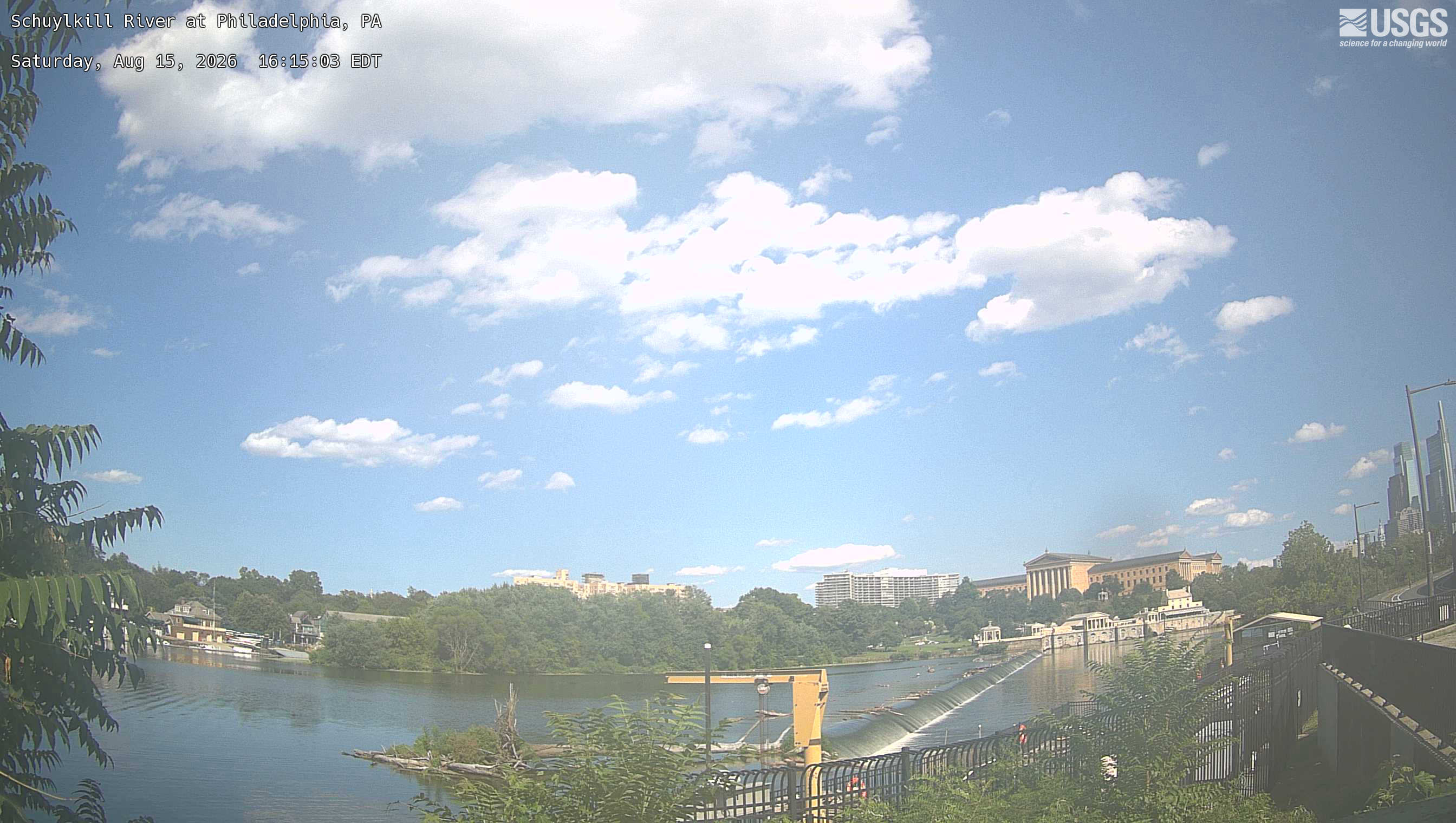
- USGS gauge 01474500 – The gauge every rower on the Row watches, now with that camera attached. It carries live stage and discharge readings. In short, this page tells you whether crews will be out.
- EarthCam at the Franklin Institute – A live stream down the Benjamin Franklin Parkway toward the Art Museum. Useful for weather and crowds.
- River conditions and flow limits – Our own page of gauges, water quality, and weather sources.
Where to Eat
Food is the one thing visiting Boathouse Row does not hand you. Usually that catches people out. Only Lloyd Hall sells anything on the Row itself, which surprises most first-timers. Everything else means a short walk inland, or a ride upstream.
- Cosmic Cafe at Lloyd Hall – Better than it needs to be. All-day breakfast, sandwiches, and coffee, plus a beer license and live music on the terrace in season. Tables sit directly over the water, with the boathouses to your right. 0 miles.
- Fairmount – The neighborhood directly behind the Row, up Fairmount Avenue. It holds the densest run of restaurants and bars within walking distance. 0.7 miles, 14 minutes.
- Brewerytown – Inland from the Girard Avenue Bridge, with cafes and taprooms in the old brewery blocks. 1.3 miles.
- East Falls – The trailside cluster, listed above. In Riva, Le Bus, Fiorino, Wissahickon Brewing, and the Saturday farmers’ market are all here. 3.6 miles.
Weddings and Events on Boathouse Row
A wedding is one of the few ways inside these buildings, and certainly the most memorable. For many people, in fact, it is the reason they came. Several clubs rent their halls, and the appeal is the same in each. You get a Victorian room, a deck over the water, the river and skyline behind your photographs, and the lights coming on as the evening goes.
Crescent’s reception room is on the second floor. It is air conditioned, holds up to 140 people, and opens onto a deck above the river. To check a date or ask about pricing, use the inquiry form on our Event Space Rentals page. It reaches the rentals team directly, so it is the fastest route to an answer. Productions and photographers should use the separate form on the Film and Photography Location Inquiry page instead.
Clubs That Rent, and Further Reading
- Crescent Boat Club – #5, mid-Row. Up to 140 guests, riverfront deck, inquiry form on the page.
- The Sedgeley Club – #15, at the lighthouse. Up to 65 seated, or 120 standing.
- University Barge Club – #7, for smaller gatherings of about 75.
- Penn AC Rowing Association – #12, also available for private events.
- Fairmount Rowing Association – #2, at the downriver end.
- Historic houses of Fairmount Park – Lemon Hill, Mount Pleasant, and their neighbors host weddings too.
- Weddings on Boathouse Row – Philly In Love on how the boathouses opened to couples.
- Waterfront venues – Philadelphia Magazine’s roundup, with a Crescent reception among them.
Visiting Boathouse Row: Common Questions
Is visiting Boathouse Row free?
Yes. Indeed the path, the lawns, the trail, and the views all cost nothing. They are open every day of the year. There is no gate, no ticket, and no visitor center.
Can you go inside the boathouses?
Unfortunately not on a walk-in basis. Fourteen of the fifteen are private clubs, so none runs public tours. Lloyd Hall is the exception, because it is a city recreation center. Otherwise the realistic routes inside are joining a club, attending a private event, or booking one yourself.
Where are the public restrooms?
Lloyd Hall, at #1. It is the only reliable public restroom on this stretch. So use it before heading upstream. Anything further up in racing season is likely portable and seasonal.
Where is the best place to photograph the Row?
The west bank, directly opposite. The Girard Avenue Bridge adds height and a three-quarter angle. Meanwhile the Spring Garden Street Bridge fits the whole Row in one frame. For the lights, arrive about twenty minutes before full dark, because you still want color in the sky.
How long does it take to walk?
Most people spend about an hour. The Row itself takes ten minutes from Lloyd Hall to the far end, so half an hour there and back. Continue to the grandstand and it becomes a four-and-a-half-mile round trip. Finally, the full loop over the Falls Bridge and down the west bank runs about eight and a half miles.
When are the lights on?
Every night, from dusk. Additionally, the strings outlining each boathouse change color for city occasions, holidays, and sporting results. That is why the Row looks different on some evenings.
Is it safe after dark?
The Row is lit every night, and security cameras cover it. Kelly Drive and the river path are generally lit too, and runners stay out well into the evening. The practical warning concerns your car rather than you. Because the Kelly Drive lots close at night, use the museum garage or a rideshare from Lloyd Hall if you are staying late.
Can I picnic on the riverbank?
Yes. The grass along Kelly Drive is open parkland, and an ordinary picnic needs no permit. However, organized gatherings, tents, amplified sound, and equipment all require one from Philadelphia Parks & Recreation.
Is it accessible?
Largely, yes. The riverfront path is paved, level, and step-free for miles in both directions. The boathouses themselves are Victorian, so most have steps at the entrance.
Can I learn to row here?
Yes, and more cheaply than most people expect. Crescent runs novice and youth programs. Philadelphia City Rowing and BLJ Community Rowing both offer free and low-cost access. The city also runs adult classes out of Lloyd Hall. See our programs or the full directory of clubs.
Planning a Trip to Philadelphia
Visiting Boathouse Row takes an hour, or a whole day. Either way, these are the places to plan the rest of the trip around it.
- Visit Philadelphia – Events, restaurants, neighborhoods, and itineraries.
- DiscoverPHL – The Convention and Visitors Bureau, with hotel and event planning information.
- Philadelphia Parks & Recreation – The department managing Fairmount Park. Accordingly it issues picnic permits and posts road closures.
Visit, Row, or Celebrate with Crescent
If visiting Boathouse Row leaves you wanting more than a look from the path, these are the ways in.
- Event space rentals – Weddings, parties, and meetings, up to 140 guests. Inquiry form on the page.
- Novice and youth programs – Learn to scull, then move into development squads and junior racing.
- Adult membership – Member types, dues, and boat storage, plus everything visiting Boathouse Row cannot show you.
- Film and photography – Location inquiries for productions, photographers, and researchers.
- Contact and club information – Officers, by-laws, and how to reach us. Naturally we answer questions about visiting Boathouse Row too.
Crescent Boat Club has rowed from #5 Boathouse Row since 1867. We have also belonged to the Schuylkill Navy of Philadelphia since 1868. It is the oldest amateur athletic governing body in the United States. Club history · Rowing links · Event rentals · Programs · Links reviewed August 2026.